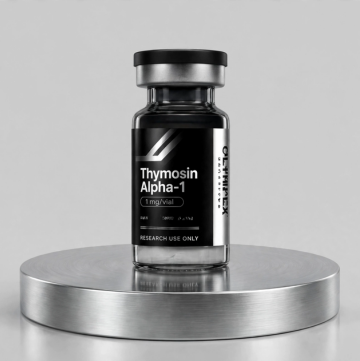
| Specification | Details |
|---|---|
| Compound | Thymosin Alpha-1 |
| Alternative Name | Thymalfasin / Tα1 |
| Type | Synthetic thymic peptide |
| Length | 28 amino acids |
| Sequence | Ac-SDAAVDTSSEITTKDLKEKKEVVEEAEN-OH |
| Quantity | 5 mg |
| Purity | ≥99% HPLC Certified |
| Form | Lyophilized powder |
| Appearance | White to off-white powder |
| Molecular Formula | C₁₂₉H₂₁₅N₃₃O₅₅ |
| Molecular Weight | 3108.3 g/mol |
| CAS Number | 69521-94-4 |
| Solubility | Soluble in laboratory-grade sterile water |
| Documentation | COA included in product image gallery |
$350.00
For Research Use Only | Not for Human or Veterinary Use
Thymosin Alpha-1 (Tα1), also known as thymalfasin, is a synthetic 28-amino-acid peptide corresponding to the N-terminal region of prothymosin alpha. The peptide is N-terminally acetylated and has been studied extensively in research involving innate and adaptive immune signaling.
This research material is supplied as a lyophilized powder for laboratory research, analytical testing, and related scientific applications.
PubChem identifies thymalfasin as a 28-residue, N-terminally acetylated peptide with the molecular formula C₁₂₉H₂₁₅N₃₃O₅₅ and molecular weight 3108.3 g/mol. PubChem lists CAS 69521-94-4 and also associates CAS 62304-98-7 with the compound.
The acetyl group is a terminal chemical modification and does not represent an additional amino-acid residue. The peptide itself contains 28 amino acids.
Thymosin Alpha-1 is derived from the N-terminal region of prothymosin alpha (PTMA). The mature peptide consists of 28 amino acids and is characterized by N-terminal acetylation. Synthetic Tα1 used in laboratory studies has been characterized by analytical methods including mass spectrometry.
Research has focused extensively on the peptide's interactions with components of the immune signaling system. Studies have investigated relationships between Tα1 and Toll-like receptors (TLRs), dendritic cells, macrophages, T cells, and other immune-cell pathways.
Experimental literature has examined Tα1 in relation to several Toll-like receptor pathways, including TLR2, TLR3, TLR4, TLR7, and TLR9. These receptors participate in innate immune recognition and downstream signaling processes involving pathways such as NF-κB, MyD88, and interferon-regulatory factors.
The exact response depends on the experimental system, receptor context, cell type, and surrounding signaling environment. These mechanistic observations should therefore be treated as research findings rather than generalized claims about the effects of research-grade material.
Dendritic cells are another major area of Tα1 research. Earlier studies investigated how Tα1 can influence dendritic-cell activity and signaling associated with innate and adaptive immune responses.
Research has also examined interactions involving plasmacytoid dendritic cells and TLR9-dependent signaling. Such studies provide a molecular framework for investigating how Tα1 may influence immune signaling in different experimental models.
Published research involving Thymosin Alpha-1 includes:
Toll-like receptor signaling
Dendritic-cell biology
Innate immune signaling
Adaptive immune signaling
Cytokine and interferon pathways
T-cell and macrophage research
Peptide structure and characterization
The literature includes cellular, animal, and clinical studies. Results from one research model should not automatically be interpreted as evidence of an equivalent effect in another model.
Thymosin Alpha-1 has been the subject of regulatory activity in the United States, including several FDA orphan-drug designations for thymalfasin. However, the FDA's orphan-drug database distinguishes designation from approval.
For example, the FDA record for a thymalfasin designation dated March 6, 2000 lists the orphan designation for hepatocellular carcinoma while stating “Not FDA Approved for Orphan Indication.” Similar FDA records for other thymalfasin designations also show designation without FDA approval for the specified orphan indication.
Therefore, an orphan-drug designation should not be described as FDA approval of Thymosin Alpha-1 or of this research-grade material.
The supplied material is specified at ≥99% HPLC-certified purity, with the COA available through the product image gallery.
For laboratory work, the batch-specific COA should be treated as the primary reference for the supplied material. Analytical documentation can provide information about the particular batch's identity and purity and should be considered separately from published literature concerning other preparations.
Thymosin Alpha-1 is a synthetic 28-amino-acid peptide also known as thymalfasin or Tα1. It corresponds to the N-terminal peptide region of prothymosin alpha.
Thymosin Alpha-1 contains 28 amino-acid residues. Its reported sequence is Ac-SDAAVDTSSEITTKDLKEKKEVVEEAEN-OH.
PubChem lists the molecular weight of thymalfasin as approximately 3108.3 g/mol. This value corresponds to the N-terminally acetylated peptide represented in the PubChem record.
Thymosin Alpha-1 corresponds to the N-terminal 28-amino-acid region of prothymosin alpha. It is therefore a much shorter peptide than the full precursor protein.
Research has investigated Tα1 in connection with Toll-like receptors and downstream signaling involving pathways such as MyD88, NF-κB, and interferon-regulatory factors. Studies have also examined dendritic-cell and other immune-cell responses.
No. FDA orphan designation and FDA marketing approval are separate regulatory actions. Current FDA records for several thymalfasin orphan designations state that the compound was not FDA approved for the corresponding orphan indication.
Thymosin Alpha-1 | The 10-Pack is supplied as a laboratory research material with ≥99% HPLC-certified purity and batch documentation available through the product gallery.
For Research Use Only | Not for Human or Veterinary Use
This material is intended strictly for laboratory research, analytical, and scientific applications. It is not intended for human or veterinary administration, diagnostic use, or therapeutic use.