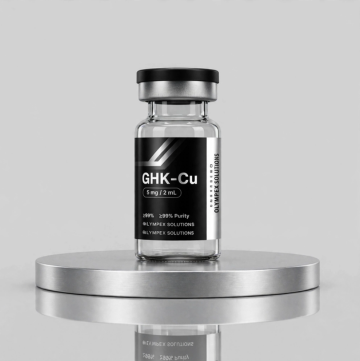
| Specification | Details |
|---|---|
| Compound | GHK-Cu |
| Full Name | Glycyl-L-Histidyl-L-Lysine Copper(II) Complex |
| Type | Copper-bound tripeptide |
| Sequence | Gly-His-Lys (GHK) complexed with Cu²⁺ |
| Length | 3 amino acids |
| Quantity | 50 mg |
| Purity | ≥99% HPLC Certified |
| Form | Lyophilized powder |
| Appearance | White to off-white powder |
| Molecular Formula | C₁₄H₂₂CuN₆O₄ |
| Molecular Weight | 401.91 g/mol |
| CAS Number | 89030-95-5 |
| Solubility | Soluble in laboratory-grade sterile water |
| Documentation | COA included in product image gallery |
$400.00
For Research Use Only | Not for Human or Veterinary Use
GHK-Cu, also known as copper tripeptide, is a copper(II) complex of the naturally occurring tripeptide glycyl-L-histidyl-L-lysine (GHK). Scientific research has examined the molecular structure of GHK-Cu, its copper-binding properties, and its interactions with cellular and extracellular systems.
This research material is supplied as a lyophilized powder for laboratory research, analytical testing, and related scientific applications.
PubChem identifies GHK-Cu as a copper complex of glycyl-L-histidyl-L-lysine with the molecular formula C₁₄H₂₂CuN₆O₄ and molecular weight 401.91 g/mol. The free GHK tripeptide is a different chemical species, with its own molecular identity and molecular weight.
GHK is a naturally occurring tripeptide composed of glycine, histidine, and lysine. It has a strong affinity for copper(II), allowing it to form the GHK-Cu complex. Structural studies have examined how copper coordinates with nitrogen-containing groups within the peptide.
The copper ion is therefore part of the molecular identity of GHK-Cu rather than simply an additional ingredient. This distinction is important when interpreting analytical data because the free peptide and copper complex have different chemical compositions.
Research into GHK-Cu has characterized the coordination of Cu²⁺ with the peptide. Experimental work has used techniques including spectroscopy and structural analysis to investigate the copper-binding arrangement and properties of the resulting complex.
The GHK-Cu complex has therefore been studied as a defined copper-binding peptide system rather than simply as a mixture of GHK and copper.
Published research involving GHK and GHK-Cu has examined areas including:
Copper-peptide coordination chemistry
Extracellular matrix research
Fibroblast biology
Cellular signaling
Protein and gene-expression studies
Tissue-remodeling models
Peptide-copper interactions
For example, an early experimental study investigated GHK-Cu in cultured fibroblasts and reported changes in collagen synthesis. Such findings are model-specific and should not be interpreted as evidence of an established effect from research-grade material.
More recent reviews continue to describe GHK-Cu as a subject of preclinical research while noting that the human clinical literature remains limited and fragmented.
The terms GHK and GHK-Cu should not be treated as interchangeable chemical identities.
| Feature | GHK | GHK-Cu |
|---|---|---|
| Chemical type | Free tripeptide | Copper(II) complex |
| Sequence | Gly-His-Lys | Gly-His-Lys + Cu²⁺ |
| Copper | Not part of the free peptide | Part of the complex |
| CAS | 49557-75-7 | 89030-95-5 |
| Molecular weight | ~340.38 g/mol | 401.91 g/mol |
The distinction is reflected in chemical databases, where the free peptide and copper complex are represented as separate molecular records.
The supplied material is specified at ≥99% HPLC-certified purity, with the COA available through the product image gallery.
For laboratory analysis, the batch-specific COA should be treated as the primary reference for the supplied material. In particular, analytical documentation can help confirm the identity and purity of the copper-bound species rather than relying only on the general GHK name.
GHK-Cu refers to the copper(II) complex of glycyl-L-histidyl-L-lysine, a three-amino-acid peptide. The copper ion is incorporated into the defined molecular complex.
The peptide component has the sequence Gly-His-Lys (GHK). GHK-Cu is formed when this tripeptide coordinates with Cu²⁺.
No. GHK is the free tripeptide, while GHK-Cu is its copper(II) complex. They have different molecular formulas, molecular weights, and registry identifiers.
The molecular weight listed by PubChem for the GHK-Cu copper complex is 401.91 g/mol.
Copper(II) is coordinated by donor atoms within the GHK peptide. This coordination creates the copper-peptide complex that is chemically distinct from uncomplexed GHK.
Research has examined GHK-Cu in copper-binding chemistry, fibroblast and extracellular-matrix models, cellular signaling, and tissue-remodeling research. The evidence varies by model and study design, with much of the mechanistic literature being preclinical.
GHK-CU | The 10 Pack is supplied as a laboratory research material with ≥99% HPLC-certified purity and batch documentation available through the product gallery.
For Research Use Only | Not for Human or Veterinary Use
This material is intended strictly for laboratory research, analytical, and scientific applications. It is not intended for human or veterinary administration, diagnostic use, or therapeutic use.