| Specification | Details |
|---|---|
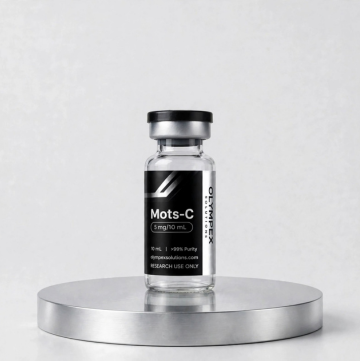
| Compound | MOTS-c |
| Full Name | Mitochondrial open reading frame of the 12S rRNA-c |
| Type | Mitochondria-derived peptide |
| Length | 16 amino acids |
| Sequence | MRWQEMGYIFYPRKLR |
| Quantity | 10 mg |
| Purity | ≥99% HPLC Certified |
| Form | Lyophilized powder |
| Appearance | White to off-white powder |
| Molecular Formula | C₁₀₁H₁₅₂N₂₈O₂₂S₂ |
| Molecular Weight | 2174.6 g/mol |
| CAS Number | 1627580-64-6 |
| Solubility | Soluble in laboratory-grade sterile water |
| Documentation | COA included in product image gallery |
$400.00
For Research Use Only | Not for Human or Veterinary Use
MOTS-c, short for mitochondrial open reading frame of the 12S rRNA-c, is a 16-amino-acid peptide encoded within the mitochondrial genome. Research has focused on its role in mitochondrial-to-nuclear signaling, metabolic stress responses, and the AMPK pathway.
This research material is supplied in lyophilized powder form for laboratory research, analytical testing, and related scientific applications.
PubChem lists MOTS-c as a 16-residue peptide with the sequence MRWQEMGYIFYPRKLR, molecular formula C₁₀₁H₁₅₂N₂₈O₂₂S₂, molecular weight 2174.6 g/mol, and CAS 1627580-64-6. PubChem also contains separate records for salt forms, so the batch-specific COA should be used to confirm the exact material form.
MOTS-c was identified as a peptide encoded by a short open reading frame within the mitochondrial 12S ribosomal RNA gene. The original research described a 16-amino-acid peptide and investigated its relationship with metabolic signaling and cellular energy regulation.
Research has linked MOTS-c to the AMP-activated protein kinase (AMPK) pathway, an important cellular energy-sensing system. Early mechanistic work proposed that MOTS-c affects the folate cycle and de novo purine biosynthesis, leading to changes in metabolites associated with AMPK activation.
These findings have made MOTS-c a subject of laboratory research into metabolic signaling and cellular responses to changes in nutrient and energy availability.
One distinctive feature of MOTS-c research is its reported movement from the cytoplasm into the nucleus during metabolic stress. A 2018 study found that this nuclear translocation was dependent on AMPK activity and that nuclear MOTS-c interacted with stress-responsive transcriptional mechanisms, including NRF2-related pathways.
This work provides a research model for studying mitonuclear communication, where signals originating from mitochondria can influence nuclear gene expression.
Published studies have investigated MOTS-c in areas including:
Mitochondrial-derived peptide biology
AMPK signaling
Folate and purine metabolism
Metabolic stress responses
Mitonuclear communication
Nuclear gene regulation
Cellular stress-response pathways
Much of the mechanistic evidence comes from cellular and animal research. Findings from these models should not be presented as established clinical effects in humans.
MOTS-c is specifically listed by the World Anti-Doping Agency (WADA) under S4.4.1 – Metabolic Modulators in the 2026 Prohibited List. The category includes activators of AMP-activated protein kinase (AMPK), with MOTS-c named as an example.
This classification is relevant to athletes and organizations operating under the World Anti-Doping Code. It does not change the designation of this product as a laboratory research material.
The product is supplied with ≥99% HPLC-certified purity, with the COA available through the product image gallery.
For laboratory work, the batch-specific COA should be used as the primary reference for the identity, purity, and analytical characteristics of the supplied material. Researchers should also account for the specific molecular form represented by the tested batch.
MOTS-c stands for mitochondrial open reading frame of the 12S rRNA-c. The name refers to the mitochondrial genomic region from which the peptide is encoded.
MOTS-c is a 16-amino-acid peptide. Its reported sequence is MRWQEMGYIFYPRKLR.
MOTS-c is encoded within the mitochondrial genome, specifically in a short open reading frame associated with the 12S rRNA gene. This distinguishes it from peptides encoded by conventional nuclear genes.
Research in cultured cells has shown that metabolic stress can promote MOTS-c translocation into the nucleus. The 2018 study reported that this process was dependent on AMPK activity.
A major research focus is the AMPK pathway, alongside folate and purine metabolism. Studies have investigated how these pathways may connect mitochondrial signals with cellular metabolic responses.
Yes. The 2026 WADA Prohibited List specifically names MOTS-c under S4.4.1, within the metabolic-modulator category covering AMPK activators.
MOTS-C | The 10 Pack is supplied as a laboratory research material with ≥99% HPLC-certified purity and batch documentation available through the product gallery.
For Research Use Only | Not for Human or Veterinary Use
This material is intended strictly for laboratory research, analytical, and scientific applications. It is not intended for human or veterinary administration, diagnostic use, or therapeutic use.