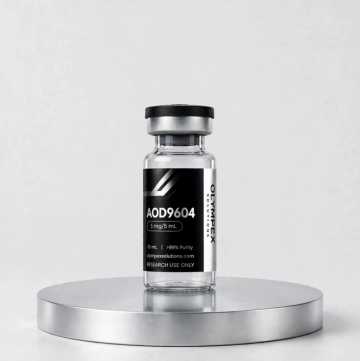
| Specification | Details |
|---|---|
| Compound | AOD-9604 |
| Type | Synthetic growth hormone fragment |
| Sequence | YLRIVQCRSVEGSCGF |
| Length | 16 amino acids |
| Quantity | 5 mg |
| Purity | ≥99% HPLC Certified |
| Form | Lyophilized powder |
| Appearance | White to off-white powder |
| Molecular Formula | C₇₈H₁₂₃N₂₃O₂₃S₂ |
| Molecular Weight | 1815.1 g/mol |
| CAS Number | 221231-10-3 |
| Solubility | Soluble in laboratory-grade sterile water |
| Documentation | COA included in product image gallery |
$350.00
For Research Use Only | Not for Human or Veterinary Use
AOD-9604 is a synthetic 16-amino-acid peptide fragment derived from the C-terminal region of human growth hormone. It has been studied in laboratory research involving lipid metabolism, adipocyte biology, and signaling pathways associated with the growth hormone fragment.
This research material is supplied in lyophilized powder form for laboratory research, analytical testing, and related scientific applications.
PubChem identifies AOD-9604 as a 16-residue peptide with a disulfide bridge between Cys7 and Cys14. The molecular form listed above is the free-base form; acetate is a separate salt form with a different molecular formula and molecular weight.
AOD-9604 is associated with the C-terminal region of human growth hormone and is sometimes described in the literature as a modified form of the 177–191 growth hormone fragment. Its sequence contains two cysteine residues that form an intramolecular disulfide bond between positions 7 and 14.
Early experimental research examined AOD-9604 in relation to lipid metabolism and adipose-tissue biology. For example, a 2001 mouse study investigated its effects on lipolysis, beta-adrenergic signaling, and expression of the beta-3 adrenergic receptor. These findings are experimental and should not be interpreted as evidence of an established effect in humans.
The peptide contains 16 amino acid residues:
YLRIVQCRSVEGSCGF
The two cysteine residues are linked through a disulfide bridge. This structural feature is important when evaluating the chemical identity and stability of the compound because disulfide bonds can participate in reduction, degradation, and aggregation processes.
Published work has investigated AOD-9604 in areas including:
Lipid metabolism
Adipocyte and adipose-tissue biology
Lipolytic signaling
Beta-adrenergic pathway research
Growth hormone fragment biology
Peptide structure and characterization
The available literature spans experimental and clinical-development research, but the evidence should be considered in the context of the specific model, formulation, and study design rather than treated as a general clinical claim.
FDA materials discussing AOD-9604 identify limited safety information and concerns related to peptide characterization, peptide-related impurities, aggregation, and potential immunogenicity for certain proposed routes of administration. FDA also noted that some submitted characterization information did not include testing for impurities, aggregates, bioburden, or bacterial endotoxins.
These regulatory observations are particularly relevant when evaluating research materials because HPLC purity alone does not represent every possible quality attribute of a peptide. Batch-specific analytical documentation should therefore be reviewed for the actual material supplied.
AOD-9604 is specifically listed by the World Anti-Doping Agency (WADA) under S2.2.3 as a growth hormone fragment. WADA's prohibited list includes AOD-9604 and hGH 176-191 among growth hormone fragments prohibited under the applicable anti-doping rules.
This classification concerns anti-doping rules and does not change the product's designation as a laboratory research material.
The product is supplied with ≥99% HPLC-certified purity, with a COA available through the product image gallery.
For analytical work, researchers should use the batch-specific COA as the primary reference for the supplied material. Where relevant, the COA should be reviewed alongside the intended research protocol and applicable laboratory quality requirements.
AOD-9604 is a synthetic peptide fragment associated with the C-terminal region of human growth hormone. It contains 16 amino acid residues and has its own defined sequence and disulfide structure.
The reported sequence is YLRIVQCRSVEGSCGF. Cysteine residues at positions 7 and 14 form an intramolecular disulfide bridge.
No. AOD-9604 is a short synthetic peptide fragment rather than the complete human growth hormone protein. Its 16-residue sequence is substantially smaller than the full-length growth hormone molecule.
PubChem lists the molecular weight of the free-base molecular form as 1815.1 g/mol. Acetate and other salt forms can have different molecular weights.
The disulfide bond connects Cys7 and Cys14 and contributes to the peptide's defined molecular structure. FDA materials have also discussed the potential for disulfide-bond reduction and aggregate formation when evaluating the compound's characterization.
Yes. WADA lists AOD-9604 under its prohibited growth hormone fragments in S2.2.3. This classification applies within the World Anti-Doping Code and applicable anti-doping rules.
AOD-9604 | The 10-Pack is supplied as a laboratory research material with ≥99% HPLC-certified purity and batch documentation available through the product gallery.
For Research Use Only | Not for Human or Veterinary Use
This material is intended strictly for laboratory research, analytical, and scientific applications. It is not intended for human or veterinary administration, diagnostic use, or therapeutic use.