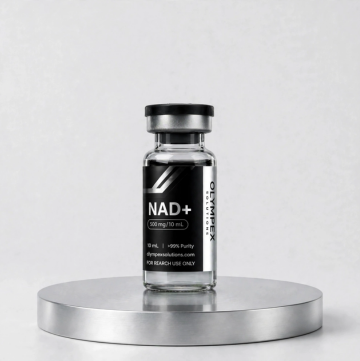
| Specification | Details |
|---|---|
| Compound | NAD+ |
| Full Name | Nicotinamide Adenine Dinucleotide |
| Type | Cellular coenzyme / dinucleotide |
| Quantity | 500 mg |
| Purity | ≥99% HPLC Certified |
| Form | Lyophilized powder |
| Appearance | White to off-white powder |
| Solubility | Soluble in laboratory-grade sterile water |
| Molecular Formula | C₂₁H₂₇N₇O₁₄P₂ |
| Molecular Weight | 663.4 g/mol |
| CAS Number | 53-84-9 |
| Documentation | COA included in product image gallery |
$500.00 Original price was: $500.00.$450.00Current price is: $450.00.
For Research Use Only | Not for Human or Veterinary Use
NAD+ (nicotinamide adenine dinucleotide) is a naturally occurring dinucleotide coenzyme involved in cellular redox reactions and NAD-dependent biochemical processes. The NAD+/NADH pair supports electron transfer, while NAD+ also serves as a substrate for several signaling enzymes.
This research material is supplied as a lyophilized powder for laboratory research, analytical testing, and related scientific applications.
PubChem identifies beta-nicotinamide adenine dinucleotide with the formula C₂₁H₂₇N₇O₁₄P₂, molecular weight of approximately 663.4 g/mol, and CAS number 53-84-9. Different salt or protonation forms can have different reported specifications, so the batch-specific COA should remain the primary reference for the supplied material.
NAD+ is the oxidized member of the NAD+/NADH redox couple. In redox reactions, NAD+ can accept electrons and become NADH, while NADH can subsequently donate electrons back through enzyme-catalyzed reactions. This reversible system is central to studies of cellular metabolism and redox balance.
NAD+ also has functions beyond electron transfer. It serves as a substrate for enzyme families including sirtuins, PARPs, and CD38-related enzymes, linking NAD metabolism with protein modification, signaling, and DNA-maintenance research.
NAD+/NADH redox biology
Cellular metabolic pathways
NAD biosynthesis and salvage
NAD-dependent enzyme activity
Sirtuin and PARP research
Cellular signaling and redox regulation
NAD+ and NADH are chemically related redox forms of the same dinucleotide coenzyme. Their reversible conversion allows NAD to participate in electron-transfer reactions associated with metabolic pathways.
| Characteristic | NAD+ | NADH |
|---|---|---|
| Redox state | Oxidized | Reduced |
| Primary role | Electron acceptor | Electron donor |
| Relationship | Oxidized form | Reduced form |
| Research relevance | Redox and enzyme-substrate studies | Electron-transfer and metabolic studies |
The NAD+/NADH balance is studied across different cellular compartments because NAD metabolism and redox reactions can vary between the cytosol, mitochondria, and nucleus.
NAD+ is not used only in oxidation-reduction reactions. Several enzyme families consume NAD+ as a substrate during biochemical reactions. These include sirtuins, poly(ADP-ribose) polymerases (PARPs), and NADases such as CD38.
This makes NAD+ research relevant to studies examining the relationship between cellular metabolism and processes such as protein modification, DNA damage responses, and signaling. These areas remain active subjects of biochemical and cellular research.
Cells maintain NAD+ through several biosynthetic and salvage pathways. Research has identified precursor-based pathways involving compounds such as nicotinamide, nicotinic acid, tryptophan, and nicotinamide riboside.
NAD+ is also continuously consumed by NAD-dependent enzymes. Cellular salvage pathways recycle components generated during this consumption, helping maintain NAD+ pools within different cellular compartments.
A Certificate of Analysis (COA) is included in the product image gallery. Researchers should review the batch-specific documentation to verify identity, reported purity, and other available analytical characteristics.
Where the supplied material is presented in a particular salt or chemical form, the batch documentation should be used to confirm the applicable molecular specifications rather than assuming that the free-form NAD+ values apply.
NAD+ stands for nicotinamide adenine dinucleotide. It is a cellular dinucleotide coenzyme involved in redox reactions and NAD-dependent biochemical processes.
No. NAD+ is a dinucleotide coenzyme, not a peptide. It consists of two nucleotide-derived units linked through phosphate groups.
NAD+ is the oxidized form of the NAD redox couple, while NADH is its reduced form. NAD+ accepts electrons during certain reactions, whereas NADH can donate them in other enzyme-catalyzed reactions.
NAD+ is consumed as a substrate by enzyme families including sirtuins, PARPs, and CD38-related enzymes. These reactions are studied in cellular signaling and protein-modification research.
Cells maintain NAD+ through multiple biosynthetic and salvage pathways. NAD+ is continuously consumed by cellular enzymes, while precursor recycling helps replenish intracellular NAD+ pools.
The batch-specific COA should be reviewed for compound identity, reported purity, analytical results, and chemical form. Researchers should use the supplied documentation when recording specifications for an individual batch.
NAD+ | The 10-Pack contains 500 mg of lyophilized research material with ≥99% HPLC-certified purity. A Certificate of Analysis is included in the product image gallery for laboratory review.
Researchers should verify the batch-specific COA before incorporating the material into experimental or analytical workflows.
For Research Use Only | Not for Human or Veterinary Use.