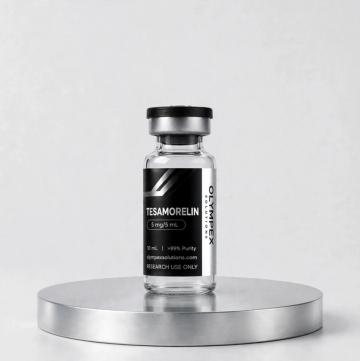
| Specification | Details |
|---|---|
| Compound | Tesamorelin |
| Type | Synthetic GHRH analogue |
| Quantity | 10 mg |
| Purity | ≥99% HPLC Certified |
| Form | Lyophilized powder |
| Appearance | White to off-white powder |
| Solubility | Soluble in laboratory-grade sterile water |
| Sequence | YADAIFTNSYRKVLGQLSARKLLQDIMSRQQGESNQERGARARL |
| Molecular Formula | C₂₂₁H₃₆₆N₇₂O₆₇S |
| Molecular Weight | 5136 g/mol |
| CAS Number | 218949-48-5 |
| Documentation | COA included in product image gallery |
$675.00
For Research Use Only | Not for Human or Veterinary Use
Tesamorelin is a synthetic analogue of growth hormone-releasing hormone (GHRH). It is based on the 44-amino-acid human GHRH sequence and contains a C-terminal modification that contributes to its stability as a GHRH analogue.
This research material is supplied as a lyophilized powder for laboratory research, analytical testing, and related scientific applications.
PubChem identifies tesamorelin with the molecular formula C₂₂₁H₃₆₆N₇₂O₆₇S, molecular weight of approximately 5136 g/mol, and CAS number 218949-48-5. PubChem also lists the 44-residue sequence associated with tesamorelin.
Tesamorelin is structurally related to human GHRH, a 44-amino-acid hypothalamic peptide involved in regulation of growth hormone secretion. GHRH acts through the GHRH receptor, a G-protein-coupled receptor expressed on pituitary somatotroph cells.
The tesamorelin sequence corresponds to GHRH residues 1–44 with a C-terminal modification. This structural design has been studied in relation to GHRH receptor signaling and the regulation of the growth hormone axis.
Synthetic GHRH analogue
44-amino-acid peptide sequence
GHRH receptor-related research
Growth hormone axis research
Peptide structure and characterization
Endocrine and receptor-signaling studies
Tesamorelin is derived from the sequence of human GHRH but is not simply native GHRH. Its structure includes a C-terminal modification, represented in the chemical record by the modified terminal portion of the molecule.
| Feature | Human GHRH | Tesamorelin |
|---|---|---|
| Peptide length | 44 amino acids | 44 amino acids |
| Relationship | Endogenous hypothalamic peptide | Synthetic GHRH analogue |
| Receptor research | GHRH receptor | GHRH receptor |
| C-terminal structure | Amidated native peptide | Modified C-terminal structure |
Human GHRH was originally characterized as a 44-residue amidated peptide, while tesamorelin was developed as a stabilized synthetic analogue.
Tesamorelin has a documented U.S. regulatory history. The FDA's Purple Book lists Egrifta, Egrifta SV, and Egrifta WR as licensed biological products containing tesamorelin, with the original approval dated November 10, 2010.
Current FDA labeling identifies EGRIFTA SV and EGRIFTA WR as specific tesamorelin pharmaceutical formulations. The FDA-approved indication is specific to reduction of excess abdominal fat in HIV-infected adults with lipodystrophy, and the label explicitly states that these products are not indicated for weight-loss management.
That approval applies to the specified FDA-regulated pharmaceutical products and formulations. It should not be interpreted as approval of this 10 mg research-grade lyophilized material.
A Certificate of Analysis (COA) is included in the product image gallery. Researchers should review the batch-specific documentation to verify identity, reported purity, and other available analytical characteristics.
Tesamorelin acetate is a distinct salt form. PubChem reports a separate molecular formula and molecular weight for tesamorelin acetate, so the applicable batch documentation should be used when determining the exact chemical form of a supplied material.
Tesamorelin is a synthetic analogue of human growth hormone-releasing hormone (GHRH). It is structurally based on the 44-amino-acid GHRH sequence.
Tesamorelin contains 44 amino-acid residues in its peptide sequence, corresponding to the length of human GHRH. Its terminal chemistry differs from native GHRH.
Tesamorelin is a GHRH analogue and is studied in relation to the growth hormone-releasing hormone receptor (GHRHR), which is expressed on pituitary somatotroph cells.
No. Tesamorelin is a synthetic analogue based on human GHRH. Its peptide sequence has modified terminal chemistry that distinguishes it from the native hormone.
Specific tesamorelin pharmaceutical products, including Egrifta and its later formulations, have FDA approval. That regulatory status applies to those defined pharmaceutical products and their labeled uses, not automatically to research-grade tesamorelin materials.
The batch-specific COA should be reviewed for identity, reported purity, analytical results, and chemical form. Researchers should use the supplied documentation when recording specifications for an individual batch.
Tesamorelin | The 10 Pack contains 10 mg of lyophilized research material with ≥99% HPLC-certified purity. A Certificate of Analysis is included in the product image gallery for laboratory review.
Researchers should verify the batch-specific COA before incorporating the material into experimental or analytical workflows.
For Research Use Only | Not for Human or Veterinary Use.