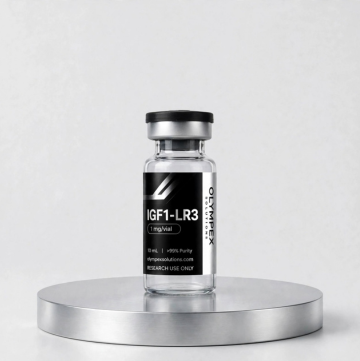
| Specification | Details |
|---|---|
| Compound | IGF-1 LR3 |
| Full Name | Long-[Arg3] Insulin-Like Growth Factor-I |
| Type | Modified IGF-I protein analogue |
| Quantity | 1 mg |
| Purity | ≥99% HPLC Certified |
| Form | Lyophilized powder |
| Appearance | White to off-white powder |
| Solubility | Soluble in laboratory-grade sterile water |
| Length | 83 amino acids |
| Modification | 13-residue N-terminal extension + Glu3→Arg substitution |
| CAS Number | 143045-27-6 |
| Documentation | COA included in product image gallery |
$600.00
For Research Use Only | Not for Human or Veterinary Use
IGF-1 LR3, also known as Long-[Arg3]IGF-I, is a modified analogue of human insulin-like growth factor-I (IGF-I). It contains a 13-amino-acid N-terminal extension and an Arg substitution at position 3, producing a distinct molecular form that has been investigated in structural, receptor-binding, and protein-folding research.
This research material is supplied as a lyophilized powder for laboratory research, analytical testing, and related scientific applications.
The 83-residue structure follows from the 13-residue N-terminal extension added to the 70-residue mature IGF-I chain. The defining Arg3 substitution replaces the glutamate found at position 3 of native mature IGF-I.
Long-[Arg3]IGF-I was developed as a structural analogue of IGF-I and has been studied using biochemical and structural methods. NMR research found that the IGF-I portion of the molecule retains a structure broadly similar to native IGF-I, while the N-terminal extension shows greater conformational flexibility.
Research has also examined how the Arg3 substitution and N-terminal extension affect interactions with IGF-binding proteins (IGFBPs). Structural studies reported lower binding affinity to IGFBPs compared with native IGF-I, providing a basis for investigating the relationship between IGF-I structure and protein-binding behavior.
IGF-I analogue structure
Protein folding and disulfide-bond formation
IGF-I receptor biology
IGF-binding protein interactions
Recombinant protein characterization
NMR and structural biology research
IGF-1 LR3 differs from native mature IGF-I in two principal ways: its 13-residue N-terminal extension and the substitution of arginine for glutamate at position 3. These modifications make it chemically distinct from recombinant human IGF-I products such as mecasermin.
| Feature | Native mature IGF-I | IGF-1 LR3 |
|---|---|---|
| Length | 70 amino acids | 83 amino acids |
| N-terminal extension | None | 13 amino acids |
| Position 3 | Glutamate | Arginine |
| Structure | Native IGF-I | Modified IGF-I analogue |
| Research focus | IGF-I biology | Analogue structure and protein interactions |
The molecule also contains the conserved cysteine residues responsible for the three intramolecular disulfide bonds characteristic of the IGF-I structural framework. Research has specifically examined the folding pathway and formation of these disulfide bonds in Long-[Arg3]IGF-I.
IGF-1 LR3 should not be treated as simply another name for native IGF-I. The additional N-terminal residues and Arg3 substitution create a separate molecular species with distinct structural and binding characteristics.
It is also different from Des(1-3)IGF-I, which is a truncated IGF-I variant lacking the first three amino acids. These are separate IGF-I analogues with different structural modifications.
IGF-1 LR3 is distinct from approved recombinant human IGF-I products. The FDA-linked substance record identifies Long-(Arg3)IGF-I as IGF-1 LR3, but this substance record should not be interpreted as FDA marketing approval.
The FDA-approved IGF-I drug mecasermin is a different molecular product from Long-[Arg3]IGF-I. Therefore, regulatory status for mecasermin should not be presented as approval of IGF-1 LR3 research material.
A Certificate of Analysis (COA) is included in the product image gallery. Researchers should review the batch-specific documentation for identity, reported purity, and other available analytical characteristics before incorporating the material into laboratory workflows.
Because IGF-1 LR3 is a modified protein analogue, the exact sequence, molecular form, and analytical characterization should be confirmed against the batch documentation.
LR3 refers to Long-[Arg3]IGF-I. “Long” describes the 13-amino-acid N-terminal extension, while “Arg3” refers to the substitution of arginine for glutamate at position 3.
Long-[Arg3]IGF-I contains 83 amino acids: the 70-residue mature IGF-I sequence plus a 13-residue N-terminal extension.
IGF-1 LR3 contains an additional 13-residue N-terminal sequence and an Arg3 substitution. Native mature human IGF-I does not contain these two modifications.
No. Des(1-3)IGF-I is a truncated IGF-I variant missing the first three amino acids, whereas IGF-1 LR3 contains a 13-residue N-terminal extension and an Arg3 substitution.
The FDA-linked PubChem substance record identifies 143045-27-6 for Long-(Arg3)IGF-I. Some commercial databases list other identifiers, so the batch COA should be used to confirm the identity of the supplied material.
Published work has investigated its molecular structure, conformational dynamics, protein folding, disulfide-bond formation, and interactions relevant to IGF-binding proteins. Much of this work is biochemical or structural rather than clinical.
IGF1-LR3 | The 10-Pack contains 1 mg per unit of lyophilized research material with ≥99% HPLC-certified purity. A Certificate of Analysis is included in the product image gallery for laboratory review.
Researchers should verify the batch-specific COA for identity and analytical characteristics before using the material in experimental or analytical workflows.
For Research Use Only | Not for Human or Veterinary Use.