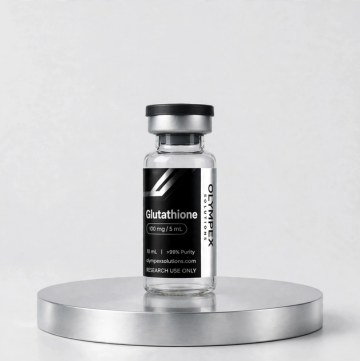
| Specification | Details |
|---|---|
| Compound | Glutathione (Reduced GSH) |
| Full Name | L-Glutathione, reduced |
| Type | Synthetic tripeptide / cellular thiol |
| Quantity | 1500 mg |
| Purity | ≥99% HPLC Certified |
| Form | Lyophilized powder |
| Appearance | White to off-white powder |
| Solubility | Soluble in laboratory-grade sterile water |
| Molecular Formula | C₁₀H₁₇N₃O₆S |
| Molecular Weight | 307.33 g/mol |
| CAS Number | 70-18-8 |
| Sequence | γ-L-glutamyl-L-cysteinyl-glycine |
| Documentation | COA included in product image gallery |
$400.00
For Research Use Only | Not for Human or Veterinary Use
Glutathione (GSH) is a naturally occurring tripeptide thiol composed of glutamate, cysteine, and glycine. It is one of the major low-molecular-weight thiols found in cells and is extensively studied in redox biology, thiol metabolism, and cellular signaling.
This research material is supplied as a lyophilized powder for laboratory research, analytical testing, and related scientific applications.
PubChem identifies reduced glutathione as a tripeptide with the molecular formula C₁₀H₁₇N₃O₆S, molecular weight of approximately 307.33 g/mol, and CAS number 70-18-8.
Glutathione contains a reactive cysteine thiol group that allows it to participate in a wide range of cellular redox reactions. Research has examined GSH metabolism in relation to redox signaling, thiol regulation, and cellular responses to reactive compounds.
GSH also participates in enzyme-mediated reactions. Glutathione peroxidases use GSH in peroxide-reduction reactions, while glutathione S-transferases use it in conjugation reactions involving electrophilic compounds. Oxidized glutathione (GSSG) can subsequently be converted back to GSH through glutathione reductase and NADPH-dependent reactions.
Cellular glutathione metabolism
Thiol and redox biology
GSH/GSSG redox systems
Glutathione-dependent enzyme activity
Protein S-glutathionylation
Cellular signaling and redox regulation
Glutathione is a tripeptide, but its structure differs from a conventional three-amino-acid peptide. The glutamate and cysteine residues are connected through the γ-carboxyl group of glutamate, creating the characteristic γ-glutamyl linkage of GSH.
| Component | Role in GSH |
|---|---|
| Glutamate | Forms the N-terminal γ-glutamyl portion |
| Cysteine | Contains the reactive thiol group |
| Glycine | Forms the C-terminal residue |
The cysteine-derived thiol is central to the redox chemistry of glutathione and its interactions with proteins and reactive molecules.
Glutathione exists primarily in reduced (GSH) and oxidized (GSSG) forms. During certain redox reactions, two GSH molecules can form glutathione disulfide, while cellular glutathione reductase systems help regenerate GSH.
| Characteristic | GSH | GSSG |
|---|---|---|
| State | Reduced | Oxidized |
| Structure | Single glutathione molecule | Two GSH units linked by a disulfide bond |
| Research relevance | Thiol chemistry and redox reactions | Indicator and product of glutathione oxidation |
| Relationship | Reduced form | Oxidized form |
This reversible relationship makes the GSH/GSSG system an important subject in studies of cellular redox state and signaling.
A Certificate of Analysis (COA) is included in the product image gallery. Researchers should review the batch-specific documentation to verify the reported purity, identity, and other available analytical characteristics.
For glutathione research, the exact chemical state is also relevant because reduced GSH and oxidized GSSG are chemically distinct species.
Yes. Glutathione is a tripeptide consisting of glutamate, cysteine, and glycine. Its unusual γ-glutamyl linkage distinguishes it from many conventional peptides.
Reduced glutathione is commonly abbreviated GSH. It contains a free cysteine thiol that participates in redox and thiol-exchange reactions.
GSSG is glutathione disulfide, the oxidized form produced when two GSH molecules become linked through their cysteine sulfur atoms. GSSG can be converted back to GSH through glutathione reductase-dependent reactions.
The cysteine residue contains the reactive thiol group that gives glutathione much of its redox chemistry. This group participates in reactions involving peroxides, electrophiles, and protein thiols.
Research has examined glutathione as a substrate or cofactor for enzymes including glutathione peroxidases, glutathione S-transferases, and glutaredoxins. These systems are involved in redox regulation and cellular thiol chemistry.
The batch-specific COA should be reviewed for identity, reported purity, analytical results, and the chemical form of the supplied material before it is incorporated into laboratory or analytical work.
Glutathione | The 10-Pack contains 1500 mg total lyophilized research material with ≥99% HPLC-certified purity. A Certificate of Analysis is included in the product image gallery for laboratory review.
Researchers should verify the batch-specific documentation before using the material in experimental or analytical workflows.
For Research Use Only | Not for Human or Veterinary Use.