| Specification | Details |
|---|---|
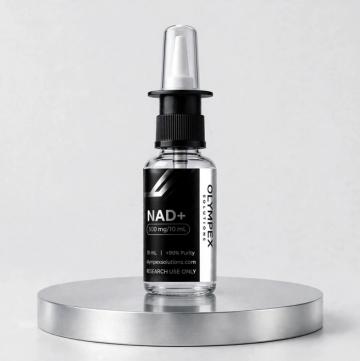
| Compound | NAD+ |
| Full Name | Nicotinamide Adenine Dinucleotide |
| Type | Cellular coenzyme / dinucleotide |
| Quantity | 500 mg |
| Purity | ≥99% HPLC Certified |
| Form | Lyophilized powder |
| Appearance | White to off-white powder |
| Solubility | Soluble in laboratory-grade sterile water |
| Molecular Formula | C₂₁H₂₇N₇O₁₄P₂ |
| Molecular Weight | 663.4 g/mol |
| CAS Number | 53-84-9 |
| Documentation | COA included in product image gallery |
$75.00
For Research Use Only | Not for Human or Veterinary Use
NAD+ (nicotinamide adenine dinucleotide) is a naturally occurring cellular coenzyme involved in oxidation-reduction reactions and a range of NAD-dependent biochemical processes. The NAD+/NADH redox pair is an important part of cellular metabolism and redox regulation.
This research material is supplied as a lyophilized powder for laboratory research, analytical testing, and related scientific applications.
PubChem identifies beta-nicotinamide adenine dinucleotide with the molecular formula C₂₁H₂₇N₇O₁₄P₂ and molecular weight of approximately 663.4 g/mol. NAD+ can also occur as different salt or protonation forms, so the batch COA should be used when documenting the exact material supplied.
NAD+ functions as an electron carrier in oxidation-reduction reactions, cycling between oxidized NAD+ and reduced NADH forms. This redox pair participates in pathways associated with glycolysis, fatty-acid oxidation, the tricarboxylic acid cycle, and oxidative phosphorylation.
NAD+ also serves as a substrate or cofactor for several enzyme systems. Research has examined NAD-dependent enzymes including sirtuins, CD38, and poly(ADP-ribose) polymerases, connecting NAD metabolism with processes such as DNA repair, chromatin regulation, and cellular signaling.
NAD+/NADH redox biology
Cellular energy metabolism
NAD biosynthesis and salvage pathways
NAD-dependent enzyme activity
DNA repair and cellular signaling
Compartmentalized NAD metabolism
NAD+ and NADH are the oxidized and reduced forms of the same nucleotide coenzyme system. Their interconversion allows NAD to participate in electron-transfer reactions throughout cellular metabolism.
| Characteristic | NAD+ | NADH |
|---|---|---|
| Redox state | Oxidized | Reduced |
| Primary research role | Electron acceptor in redox reactions | Electron donor in redox reactions |
| Relationship | Oxidized form | Reduced form |
| Research relevance | Redox signaling and metabolic pathways | Electron transfer and oxidative metabolism |
Cells maintain NAD+ through several interconnected pathways, including de novo synthesis and salvage pathways. Nicotinamide is an important precursor in the NAD salvage pathway, while NAD+ can also be converted into NADH during metabolic reactions.
NAD metabolism is also compartmentalized within cells, and research continues to examine how different cellular NAD pools are maintained and regulated.
A Certificate of Analysis (COA) is included in the product image gallery. Researchers should review the batch-specific documentation to verify the reported purity and other available analytical characteristics.
The COA should also be used to confirm the exact chemical form of the material, particularly where salt or protonation state can affect reported molecular specifications.
NAD+ stands for nicotinamide adenine dinucleotide. It is a naturally occurring cellular coenzyme that participates in redox reactions and other NAD-dependent biochemical processes.
No. NAD+ is a dinucleotide coenzyme composed of two nucleotide units linked through phosphate groups. It is chemically distinct from peptides and proteins.
NAD+ is the oxidized form, while NADH is the reduced form. The two forms cycle between each other during electron-transfer reactions involved in cellular metabolism.
NAD+ participates in reactions involving numerous enzymes, including dehydrogenases and NAD-dependent enzymes such as sirtuins, CD38, and poly(ADP-ribose) polymerases.
Cells can produce NAD+ through de novo pathways and precursor-based salvage pathways. Nicotinamide is an important substrate in the salvage pathway.
Researchers should review the batch-specific COA for identity, reported purity, analytical results, and the chemical form of the supplied material before using it in laboratory or analytical work.
NAD+ Spray is supplied as a 500 mg lyophilized research material with ≥99% HPLC-certified purity. A Certificate of Analysis is included in the product image gallery for laboratory review.
For Research Use Only | Not for Human or Veterinary Use.