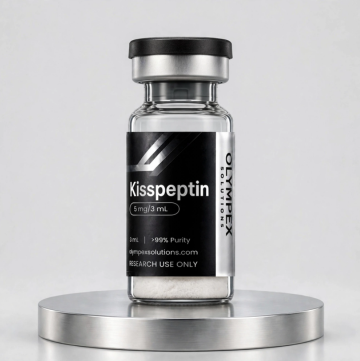
| Specification | Details |
|---|---|
| Compound | KISSPEPTIN |
| Type | Synthetic research peptide |
| Quantity | 5 mg |
| Purity | ≥99% HPLC Certified |
| Form | Lyophilized powder |
| Appearance | White to off-white powder |
| Solubility | Soluble in laboratory-grade sterile water |
| Documentation | COA included in product image gallery |
$59.99
For Research Use Only | Not for Human or Veterinary Use
Kisspeptin is a family of neuropeptides encoded by the KISS1 gene and studied for its interaction with the kisspeptin receptor, KISS1R. Kisspeptin-KISS1R signaling is closely connected with research into gonadotropin-releasing hormone (GnRH) neuronal activity and reproductive neuroendocrinology.
This research material is supplied as a lyophilized powder for laboratory research, analytical testing, and related scientific applications.
Note: Kisspeptin exists in several peptide forms, including kisspeptin-10, kisspeptin-14, kisspeptin-28, and kisspeptin-54. These forms have different molecular structures and molecular weights. The exact sequence and chemical specifications should therefore be confirmed from the batch-specific COA before assigning molecular formula, molecular weight, or CAS information to this material.
Kisspeptins are endogenous signaling peptides derived from the KISS1 gene. Their biological activity is mediated primarily through the G protein-coupled receptor KISS1R, also known as GPR54. Research has established the kisspeptin-KISS1R system as an important signaling pathway in studies of GnRH neuronal function.
Different kisspeptin fragments have been used in experimental research. For example, human kisspeptin-10 is a 10-amino-acid peptide, while kisspeptin-14 and kisspeptin-54 represent longer peptide forms. Their sequences and molecular properties are distinct, which is why the specific research material should be identified before interpreting analytical data.
Kisspeptin-KISS1R receptor signaling
GnRH neuronal research
Neuroendocrine signaling
Peptide-receptor interactions
Reproductive neuroendocrinology
Structure and function of kisspeptin peptide variants
| Peptide form | General description |
|---|---|
| Kisspeptin-10 | Short C-terminal kisspeptin fragment; 10 amino acids |
| Kisspeptin-14 | 14-amino-acid human kisspeptin fragment |
| Kisspeptin-28 | Longer kisspeptin peptide fragment |
| Kisspeptin-54 | Longer human kisspeptin form; also associated with the metastin sequence |
These are chemically distinct peptides rather than interchangeable names for one molecular structure.
A Certificate of Analysis (COA) is included in the product image gallery. Researchers should use the batch-specific documentation to confirm the exact kisspeptin form, sequence, purity, and other analytical characteristics before using the material in laboratory work.
This distinction is particularly important for kisspeptin because multiple peptide lengths are commercially and scientifically referenced under the broader kisspeptin name.
Kisspeptin refers to a group of peptides encoded by the KISS1 gene. These peptides interact with KISS1R and are widely studied in neuroendocrine signaling research.
Not necessarily. Kisspeptin-10 is one specific peptide form within the broader kisspeptin family. Other forms, including kisspeptin-14, -28, and -54, have different sequences.
KISS1R is the receptor through which kisspeptin signaling is primarily mediated. It is also known as GPR54 and is studied in connection with GnRH neuronal signaling.
Kisspeptin peptides can exist as different processed fragments derived from the KISS1 precursor. Research materials may therefore represent different peptide lengths with distinct sequences and molecular properties.
The COA should be checked for the exact peptide identity, sequence or peptide form, reported purity, batch information, and other available analytical results.
No. Molecular weight depends on the specific kisspeptin form. For example, PubChem reports approximately 1,302.4 g/mol for human kisspeptin-10 and 3,229.6 g/mol for human kisspeptin-54 (27–54).
KISSPEPTIN is supplied as a 5 mg lyophilized research material with ≥99% HPLC-certified purity. Batch documentation is available through the product image gallery for laboratory review.
Researchers should confirm the exact kisspeptin variant against the accompanying COA before using molecular specifications or analytical identifiers in research records.
For Research Use Only | Not for Human or Veterinary Use.