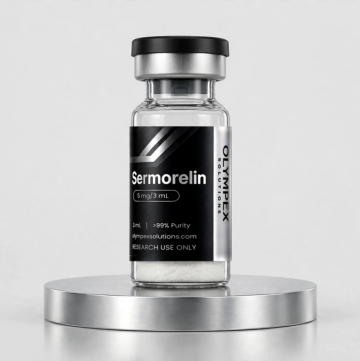
| Specification | Details |
|---|---|
| Compound | Sermorelin |
| Type | Synthetic GHRH(1-29)-NH₂ peptide |
| Sequence | YADAIFTNSYRKVLGQLSARKLLQDIMSR-NH₂ |
| Quantity | 5 mg |
| Purity | ≥99% HPLC Certified |
| Molecular Formula | C₁₄₉H₂₄₆N₄₄O₄₂S |
| Molecular Weight | 3357.9 g/mol |
| CAS Number | 86168-78-7 |
| Form | Lyophilized powder |
| Appearance | White to off-white powder |
| Solubility | Soluble in laboratory-grade sterile water |
| Documentation | COA included in product image gallery |
$49.99
For Research Use Only | Not for Human or Veterinary Use
Sermorelin is a synthetic 29-amino-acid peptide corresponding to GHRH(1-29)-NH₂, the amino-terminal segment of human growth hormone-releasing hormone (GHRH). It has been studied extensively in research involving GHRH signaling, growth hormone secretion, and the physiological regulation of the growth hormone axis.
This material is supplied as a lyophilized powder for laboratory research, analytical testing, and related scientific applications.
The molecular formula, molecular weight, sequence, and CAS number correspond to the Sermorelin record in PubChem. PubChem separately identifies sermorelin acetate as the acetate salt, with CAS 114466-38-5.
Sermorelin represents the N-terminal 29-residue portion of human GHRH and retains the amidated C-terminus characteristic of the peptide fragment. Research has examined GHRH(1-29)-NH₂ in relation to GHRH receptor signaling and stimulation of endogenous growth hormone release.
Experimental studies have included pharmacokinetic investigations in healthy adults as well as research involving growth hormone secretion and GHRH physiology. Earlier clinical research also examined GHRH(1-29)-NH₂ in children and adults in the context of growth hormone deficiency and related endocrine research.
For laboratory research, Sermorelin provides a defined 29-residue GHRH fragment that can be investigated in biochemical, analytical, receptor, and endocrine research models.
The supplied material is specified at ≥99% HPLC Certified purity, with a Certificate of Analysis included in the product image gallery.
Researchers should review the applicable batch-specific COA for the reported purity and analytical information before incorporating the material into laboratory workflows.
Sermorelin has a documented pharmaceutical history in the United States. FDA records show that sermorelin acetate (Geref) received marketing approval in 1997 for an indicated pediatric growth-hormone-deficiency use. FDA records also list the product in historical approved-drug records.
That regulatory history applies to the specific approved drug product and formulation, not automatically to every research-grade Sermorelin material. The material offered on this page is presented strictly as a laboratory research material and is not represented as the FDA-approved drug product.
Sermorelin contains 29 amino acid residues and corresponds to the GHRH(1-29)-NH₂ fragment. It represents the amino-terminal portion of the naturally occurring 44-amino-acid human GHRH sequence.
The sequence is YADAIFTNSYRKVLGQLSARKLLQDIMSR-NH₂. The C-terminal amidation is part of the defined Sermorelin structure.
Sermorelin is a 29-residue N-terminal fragment of GHRH, whereas human GHRH is a longer 44-residue peptide. Sermorelin therefore represents a defined portion rather than the complete native hormone.
Sermorelin is a GHRH fragment, and research involving GHRH(1-29)-NH₂ has examined signaling through the growth hormone-releasing hormone receptor (GHRHR). This receptor is part of the signaling system regulating growth hormone secretion.
Sermorelin acetate is the acetate salt form of Sermorelin. PubChem lists Sermorelin itself under CAS 86168-78-7 and identifies the acetate form separately under CAS 114466-38-5.
Yes. Published human research has investigated GHRH(1-29)-NH₂ in healthy adults and in studies involving growth hormone secretion. FDA records also document the historical approval of sermorelin acetate as Geref.
Sermorelin is supplied as a laboratory research material with HPLC-certified purity and batch-specific documentation available through the product gallery.
For Research Use Only | Not for Human or Veterinary Use