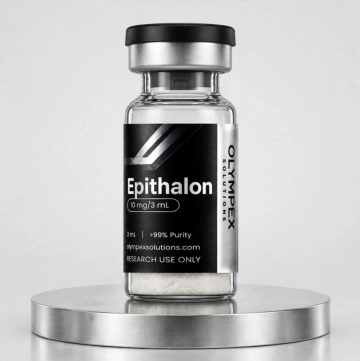
| Specification | Details |
|---|---|
| Compound | Epithalon |
| Alternative Name | Epithalon |
| Type | Synthetic tetrapeptide |
| Sequence | Ala-Glu-Asp-Gly (AEDG) |
| Quantity | 10 mg |
| Purity | ≥99% HPLC Certified |
| Molecular Formula | C₁₄H₂₂N₄O₉ |
| Molecular Weight | 390.35 g/mol |
| CAS Number | 307297-39-8 |
| Form | Lyophilized powder |
| Appearance | White to off-white powder |
| Solubility | Soluble in laboratory-grade sterile water |
| Documentation | COA included in product image gallery |
$30.00
For Research Use Only | Not for Human or Veterinary Use
Epithalon, also spelled Epithalon, is a synthetic tetrapeptide consisting of four amino acids: Ala-Glu-Asp-Gly (AEDG). It was developed in connection with research into epithalamin, a peptide preparation associated with pineal tissue, and has subsequently been examined in experimental cellular and animal models.
Published research has investigated Epithalon in areas including telomere biology, telomerase-related activity, and circadian regulation. These findings come from experimental research models and should not be interpreted as evidence of an established human application.
This material is supplied as a lyophilized powder for laboratory research, analytical testing, and related scientific applications.
The molecular formula, molecular weight, sequence, and primary CAS identifier correspond to the PubChem record for Epithalon (CID 219042).
Epithalon is a short peptide with the sequence AEDG. Its development followed research involving epithalamin, a pineal tissue preparation, with Epithalon subsequently investigated as a defined synthetic tetrapeptide.
Experimental studies have examined Epithalon in relation to telomere and telomerase biology. Other research has investigated its relationship with circadian regulation, including experimental work measuring melatonin synthesis and circadian hormone patterns in animal models.
These studies provide a basis for laboratory investigation but do not establish clinical efficacy or therapeutic use in humans.
The supplied material is specified at ≥99% HPLC Certified purity, with a Certificate of Analysis included in the product image gallery.
Researchers should review the batch-specific COA for the reported purity result and analytical information before incorporating the material into laboratory workflows.
Epithalon remains an experimental research peptide. Published literature includes cellular and animal studies examining its molecular and biological properties, including research involving telomere-related processes and circadian regulation.
The material supplied here is intended strictly for laboratory research and analytical applications and is not represented as an approved pharmaceutical, therapeutic, diagnostic, or veterinary product.
Epithalon has the four-residue sequence Ala-Glu-Asp-Gly (AEDG). The one-letter representation is AEDG.
Epithalon is a tetrapeptide, meaning it contains four amino acid residues. Its four residues are alanine, glutamic acid, aspartic acid, and glycine.
The molecular weight listed by PubChem is approximately 390.35 g/mol for the defined Epithalon molecule.
The primary CAS Registry Number associated with Epithalon is 307297-39-8. PubChem also lists 64082-79-7 among its associated identifiers.
Epithalon is a defined synthetic tetrapeptide with the sequence AEDG, whereas epithalamin refers to the pineal tissue peptide preparation from which the research surrounding Epithalon developed. They should not be treated as chemically identical materials.
Published research has included cellular and animal models. Studies have investigated areas such as telomere-related biology and circadian regulation, including experimental work in senescent monkeys.
Epithalon is supplied as a laboratory research material with HPLC-certified purity and batch-specific documentation available through the product gallery.
For Research Use Only | Not for Human or Veterinary Use