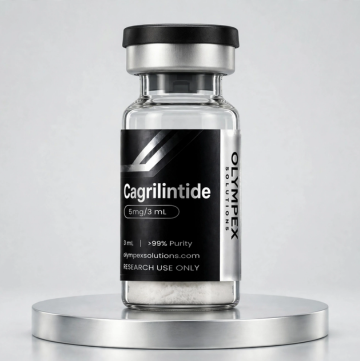
| Specification | Details |
|---|---|
| Compound | Cagrilintide |
| Alternative Names | Cagri / AM-833 / NN9838 |
| Type | Synthetic amylin analogue |
| Residues | 37 amino acids |
| Molecular Formula | C₁₉₄H₃₁₂N₅₄O₅₉S₂ |
| Molecular Weight | 4409 g/mol |
| CAS | 1415456-99-3 |
| Quantity | 5 mg |
| Purity | ≥99% HPLC Certified |
| Form | Lyophilized powder |
| Appearance | White to off-white powder |
| Solubility | Soluble in laboratory-grade sterile water |
| Documentation | Certificate of Analysis included in product documentation |
$59.99
For Research Use Only | Not for Human or Veterinary Use
Cagrilintide is a 37-residue synthetic analogue of human amylin with a lipid modification designed to alter its interaction with serum albumin and extend its circulation characteristics. It has been characterized as a long-acting dual amylin and calcitonin receptor agonist and has been investigated in biochemical, cellular, and animal research models.
Structural studies have examined how cagrilintide interacts with amylin receptor subtypes and the calcitonin receptor. These studies provide detailed information about receptor recognition, peptide conformation, and downstream receptor activation mechanisms.
The molecular formula and molecular weight are listed in the current PubChem record for cagrilintide.
Cagrilintide is derived from an amylin peptide backbone and contains structural modifications that distinguish it from native human amylin. Like other amylin-based peptides, its sequence contains a disulfide bridge within the N-terminal region and a C-terminally amidated structure. Recent structural studies have used cryo-electron microscopy to characterize cagrilintide bound to several receptor complexes.
A defining feature of cagrilintide is its lipid modification. Lipidated peptides can associate with serum albumin through their fatty-acid chains, creating an albumin-bound peptide population that can remain in circulation longer than the corresponding unmodified peptide.
For cagrilintide specifically, structural research identifies the lipid modification as part of the molecule's receptor and membrane-associated behavior. This lipidation contributes to the compound's long-acting characteristics and is an important feature when studying its pharmacokinetic properties.
Cagrilintide has been characterized as an agonist at amylin receptor complexes, including AMY1R, AMY2R, and AMY3R. These receptors are formed through combinations of the calcitonin receptor or related receptor components with receptor activity-modifying proteins (RAMPs).
Cryo-EM studies have provided structural information about how cagrilintide occupies the receptor complex and interacts with both extracellular and transmembrane receptor regions. These findings help researchers investigate the molecular basis of amylin-family receptor activation.
Cagrilintide also interacts with the calcitonin receptor (CTR). Structural and functional experiments have demonstrated receptor activation through Gs-coupled signaling and identified differences in receptor conformational behavior when cagrilintide is bound to CTR compared with amylin receptor complexes.
This dual receptor activity is one of the defining pharmacological characteristics of cagrilintide and provides a research model for studying signaling across the calcitonin-receptor family.
Recent cryo-EM work has examined cagrilintide bound to AMY1R, AMY2R, AMY3R, and CTR. The studies identified an amylin-like binding mode while also showing receptor-specific differences in peptide positioning and conformational dynamics.
Additional structural research identified several residues involved in cagrilintide-receptor interactions, including Phe23 and C-terminal residues that contribute to receptor engagement. An intramolecular interaction between residues in the peptide sequence was also reported to contribute to its helical structure.
These findings make cagrilintide useful for laboratory studies investigating peptide–GPCR recognition, receptor activation, and the structural determinants of dual amylin/calcitonin receptor activity.
Cagrilintide is supplied as a lyophilized research material with ≥99% HPLC-certified purity.
A Certificate of Analysis (COA) is included with the product documentation. Researchers should review the applicable batch-specific documentation when evaluating identity, purity, and other reported analytical characteristics.
Quantity: 5 mg
Form: Lyophilized powder
Appearance: White to off-white
Purity: ≥99% HPLC Certified
Solubility: Soluble in laboratory-grade sterile water
COA: Included in product documentation
Intended Use: Laboratory research only
Cagrilintide is derived from an amylin peptide backbone and has been structurally modified to alter its receptor interactions and circulating properties. It is a 37-residue synthetic amylin analogue.
Lipidation means that a lipid or fatty-acid-derived group has been chemically attached to the peptide. In cagrilintide, this modification contributes to albumin association and the peptide's prolonged circulation characteristics.
Amylin receptors are receptor complexes formed from the calcitonin receptor and receptor activity-modifying proteins. Different RAMP combinations produce receptor subtypes with distinct pharmacological properties.
Research has characterized cagrilintide as an agonist at AMY1R, AMY2R, AMY3R, and the calcitonin receptor. Structural studies have examined its interactions with each of these receptor systems.
Receptor activity-modifying proteins, or RAMPs, associate with the calcitonin receptor to form different amylin receptor complexes. Their combination influences receptor structure and ligand recognition.
Yes. Recent studies have used cryo-electron microscopy to determine structures of cagrilintide bound to amylin receptor and calcitonin receptor complexes. These experiments provide molecular-level information about peptide binding and receptor activation.
Review the Cagrilintide scientific specifications and applicable Certificate of Analysis when evaluating this material for laboratory research. Cagrilintide is supplied strictly as a research material and is not intended for human or veterinary use.