
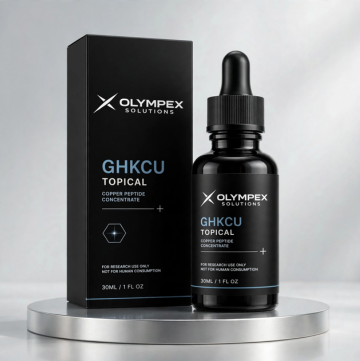
| Specification | Details |
|---|---|
| Compound | GHK-Cu |
| Chemical Description | Glycyl-L-histidyl-L-lysine copper complex |
| Research Format | Topical research formulation |
| Purity | High-purity research compound |
| Application | In-vitro laboratory research |
| Documentation | Certificate of Analysis supplied with each lot |
| Intended Use | Laboratory research only |
$49.99
For Research Use Only | Not for Human or Veterinary Use
GHK-Cu Topical is a high-purity research formulation containing GHK-Cu (glycyl-L-histidyl-L-lysine copper complex) for laboratory research applications. GHK-Cu is a copper-binding complex formed from the tripeptide glycyl-histidyl-lysine (GHK) and copper. PubChem identifies GHK-Cu as a copper complex of the GHK tripeptide.
Research involving GHK-Cu has examined its interaction with cultured cells, extracellular-matrix-related processes, and the behavior of copper and peptide components in experimental systems. Separate in-vitro skin studies have also investigated the retention and penetration of copper tripeptide formulations using excised human skin models.
This material is supplied strictly for laboratory research use. It is not intended for human or veterinary application.
Product-specific concentration, quantity, formulation composition, and other analytical specifications should be taken from the applicable batch documentation rather than inferred from the product name.
GHK-Cu consists of the tripeptide glycyl-histidyl-lysine (GHK) associated with copper. The GHK portion contains three amino acids: glycine, histidine, and lysine. PubChem records several chemical representations of GHK-Cu because copper-peptide complexes can be represented according to different coordination and charge states.
Experimental studies have investigated GHK-Cu in cultured fibroblasts and other cell systems. For example, research using dermal fibroblast cultures examined changes in matrix metalloproteinase-2 (MMP-2) expression following exposure to the copper tripeptide complex.
Other cell-based research has examined GHK-Cu in relation to extracellular matrix components and cellular attachment. These studies provide experimental information about how the copper-peptide complex behaves in controlled laboratory systems and should be interpreted within the specific conditions of each model.
Because this product is supplied in a topical research format, GHK-Cu has also been investigated using experimental skin models. One in-vitro study evaluated the penetration and retention of copper tripeptide in excised human skin using diffusion-cell methods. The study measured copper distribution within different skin layers and the receptor fluid over a 48-hour experimental period.
These experiments are useful for studying skin permeation, tissue retention, and formulation behavior under controlled laboratory conditions. Results from ex-vivo or in-vitro models should not be presented as evidence of an established outcome in humans.
Physicochemical research has examined GHK-Cu for potential dermal formulation work, including solubility, distribution characteristics, stability under stressed conditions, and compatibility with formulation components. A validated reversed-phase HPLC method has also been used to quantify GHK-Cu during experimental formulation studies.
These characteristics can be relevant when researchers are evaluating the behavior and stability of copper-peptide formulations under controlled laboratory conditions.
Each lot of GHK-Cu Topical is supplied with a Certificate of Analysis (COA).
The COA provides the applicable batch-specific analytical information for the material. Researchers should review the accompanying documentation when assessing identity, purity, and other reported quality characteristics.
Material: GHK-Cu Topical
Format: Topical research formulation
Research Application: In-vitro laboratory research
Purity: High-purity research compound
Documentation: Certificate of Analysis supplied with each lot
Intended Use: Laboratory research only
GHK-Cu is a copper-peptide complex involving the tripeptide glycyl-histidyl-lysine (GHK) and copper. It has been investigated in a range of biochemical and cell-based research models.
GHK refers to the three amino acids glycine, histidine, and lysine. In GHK-Cu, this tripeptide is associated with copper to form a copper-peptide complex.
Fibroblast studies have been used to investigate how GHK-Cu interacts with extracellular-matrix-related processes and cellular signaling. Experimental work has examined markers including MMP-2 and other matrix-associated responses.
Yes. Researchers have used excised human skin and diffusion-cell systems to examine copper tripeptide penetration and retention within skin tissue under controlled in-vitro conditions.
Research formulations of GHK-Cu have been evaluated using analytical techniques including reversed-phase HPLC. Such methods can be used to quantify the peptide and assess stability during formulation studies.
No. This product is supplied strictly as a laboratory research material for in-vitro research. It is not intended for human or veterinary use.
Review the GHK-Cu Topical product information and applicable lot-specific Certificate of Analysis when evaluating this material for laboratory research. The product is supplied strictly for research use and is not intended for human or veterinary use.