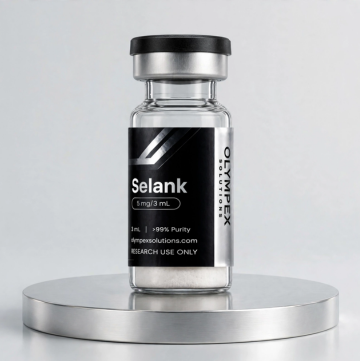
| Specification | Details |
|---|---|
| Compound | Selank |
| Alternative Name | Thr-Lys-Pro-Arg-Pro-Gly-Pro |
| Type | Synthetic heptapeptide |
| Sequence | Thr-Lys-Pro-Arg-Pro-Gly-Pro |
| Residues | 7 amino acids |
| Quantity | 5 mg |
| Purity | ≥99% HPLC Certified |
| Form | Lyophilized powder |
| Appearance | White to off-white powder |
| Solubility | Soluble in laboratory-grade sterile water |
| Documentation | Certificate of Analysis supplied with every batch |
$34.99
For Research Use Only | Not for Human or Veterinary Use
Selank is a synthetic heptapeptide composed of the sequence Thr-Lys-Pro-Arg-Pro-Gly-Pro. It is derived from the naturally occurring tetrapeptide tuftsin, Thr-Lys-Pro-Arg, with a C-terminal Pro-Gly-Pro extension. Research has examined Selank in experimental models of GABAergic signaling, neurotransmission, gene expression, and BDNF regulation.
The peptide has been studied primarily in cellular and animal research systems. These studies provide experimental information about its molecular interactions and signaling effects, but findings from preclinical models should not be interpreted as established human outcomes.
Selank extends the tuftsin sequence Thr-Lys-Pro-Arg by adding Pro-Gly-Pro at the C terminus. Experimental literature describes this seven-residue sequence as a synthetic tuftsin analogue and has investigated its effects across several neurological and biochemical research models.
GABAergic signaling is one of the principal areas investigated with Selank. Research in rat brain has reported changes in the expression of genes associated with GABA receptors, transporters, ion channels, and other neurotransmission-related proteins following experimental Selank administration.
Cell-based research has also examined Selank alongside GABA and evaluated whether the peptide alters expression patterns associated with GABAergic neurotransmission. One study found that Selank did not directly change the mRNA levels of the GABAergic genes examined in IMR-32 neuroblastoma cells, while the combined Selank/GABA treatment produced measurable changes in the experimental system.
These findings illustrate why Selank is used as a research model for examining interactions between peptide signaling and GABA-related pathways rather than being described as having a single established molecular mechanism.
Brain-derived neurotrophic factor (BDNF) is another area of Selank research. A study published in 2008 specifically investigated Selank administration and BDNF expression in the rat hippocampus in vivo.
Additional animal research has examined changes in BDNF content in the hippocampus and prefrontal cortex following experimental Selank treatment. These findings remain model-specific and are useful primarily for investigating relationships between peptide signaling and neurotrophin-related pathways.
Transcriptomic research has examined the effect of Selank on gene expression in the rat hippocampus. One study reported changes in the expression of multiple genes following experimental administration, including genes associated with plasma membrane proteins and ion-dependent cellular processes.
Together, these studies make Selank a subject of investigation in molecular neuroscience, particularly where peptide signaling, neurotransmission, and gene-expression responses intersect.
Each batch of Selank is supplied as a lyophilized research material with ≥99% HPLC-verified purity.
A Certificate of Analysis (COA) is supplied with every batch and provides the applicable analytical documentation for the material. Researchers should refer to the batch-specific COA when evaluating purity and other reported analytical characteristics.
Quantity: 5 mg
Form: Lyophilized powder
Appearance: White to off-white
Purity: ≥99% HPLC Certified
Solubility: Soluble in laboratory-grade sterile water
COA: Supplied with every batch
Intended Use: Laboratory research only
Selank is the seven-amino-acid sequence Thr-Lys-Pro-Arg-Pro-Gly-Pro. The first four residues correspond to the tuftsin sequence, while Pro-Gly-Pro forms the C-terminal extension.
Tuftsin is a naturally occurring tetrapeptide with the sequence Thr-Lys-Pro-Arg. Selank is structurally derived from this sequence through the addition of Pro-Gly-Pro at its C terminus.
GABAergic signaling refers to cellular communication involving gamma-aminobutyric acid (GABA), the principal inhibitory neurotransmitter in the central nervous system. Research on Selank has examined several components of this signaling system.
Brain-derived neurotrophic factor (BDNF) is a neurotrophin involved in neuronal signaling and plasticity. Selank research has investigated changes in BDNF expression or content in experimental brain models.
Yes. Published research has examined Selank in several animal models, including rats and mice, with studies investigating neurotransmission, gene expression, BDNF-related pathways, and other biological responses.
No. Tuftsin is a four-amino-acid peptide, while Selank is a seven-amino-acid synthetic analogue containing the complete tuftsin sequence plus a Pro-Gly-Pro extension.
Review the Selank scientific specifications and batch-specific Certificate of Analysis when evaluating this material for laboratory research. Selank is supplied strictly as a research material and is not intended for human or veterinary use.