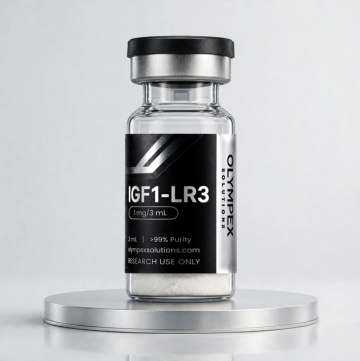
| Specification | Details |
|---|---|
| Compound | IGF1-LR3 |
| Alternative Name | Long-[Arg3]-IGF-I / LR3IGF-I |
| Type | Synthetic IGF-I analogue |
| Residues | 83 amino acids |
| Modification | Glu3 → Arg substitution |
| N-Terminal Extension | 13 amino acids |
| Form | Lyophilized powder |
| Appearance | White to off-white powder |
| Purity | ≥99% HPLC Certified |
| Solubility | Soluble in laboratory-grade sterile water |
| Documentation | Certificate of Analysis supplied with every batch |
$84.99 Original price was: $84.99.$79.99Current price is: $79.99.
For Research Use Only | Not for Human or Veterinary Use
IGF1-LR3, also known as Long-[Arg3]-IGF-I, is an 83-residue synthetic analogue of insulin-like growth factor 1 (IGF-1). It contains the native IGF-I sequence with a Glu3-to-Arg substitution and a 13-amino-acid N-terminal extension. These structural modifications were developed to alter the interaction of IGF-I with IGF-binding proteins (IGFBPs) while retaining interaction with the IGF-1 receptor.
Research on Long-[Arg3]-IGF-I has examined its structure, folding behavior, receptor interactions, and binding to IGFBPs. The analogue has been used as an experimental tool for investigating how IGFBP association influences IGF-I activity and clearance.
Native human IGF-I contains 70 amino acids. IGF1-LR3 adds a 13-residue N-terminal extension and replaces the glutamate normally present at position 3 with arginine, producing the 83-residue Long-[Arg3]-IGF-I analogue. Structural studies found that the IGF-I portion retains a structure broadly similar to native IGF-I, while the modifications alter the N-terminal region and its interactions with binding proteins.
A major research interest in IGF1-LR3 is its reduced affinity for several IGFBPs. Experimental studies have used this property to examine the relationship between IGFBP binding, IGF receptor interaction, and biological activity in experimental systems.
The reduced association with IGFBPs should not be described simply as an extension of plasma half-life. In an experimental comparison, LR3IGF-I showed lower IGFBP association and was cleared from plasma more rapidly than native IGF-I. This makes the analogue useful for studying how binding-protein interactions affect IGF-I pharmacokinetics and activity.
IGF1-LR3 has been investigated as an IGF-I receptor ligand, with research comparing its receptor and IGFBP interactions with those of native IGF-I. Studies of IGF-I analogues have shown that structural regions involved in receptor binding can overlap with regions involved in IGFBP recognition, making these analogues useful for examining receptor–binding-protein relationships.
For laboratory research, this distinction is important because changes in IGFBP association can influence how an IGF-I analogue behaves in a particular experimental system. Results can therefore depend on the model, receptor expression, binding-protein environment, and experimental conditions.
Each batch of IGF1-LR3 is supplied as a lyophilized research material with ≥99% HPLC-verified purity.
A Certificate of Analysis (COA) is supplied with every batch and provides the applicable analytical documentation for the material. Researchers should review the batch-specific documentation when evaluating purity and material identity.
Quantity: 1 mg
Form: Lyophilized powder
Appearance: White to off-white
Purity: ≥99% HPLC Certified
Solubility: Soluble in laboratory-grade sterile water
COA: Supplied with every batch
Intended Use: Laboratory research only
LR3 refers to the Long-[Arg3] form of IGF-I. The name reflects both the 13-amino-acid N-terminal extension and the substitution of arginine for glutamate at position 3.
IGF1-LR3 contains two principal structural changes: a Glu3-to-Arg substitution and a 13-residue N-terminal extension. Together, these modifications alter its interaction with IGF-binding proteins.
IGF-binding proteins, or IGFBPs, are a family of proteins that bind IGF molecules and influence their distribution, availability, and interactions within biological systems.
It has been used as an experimental analogue for studying IGF-I receptor interactions, IGFBP binding, protein structure, folding, and the relationship between binding-protein association and IGF-I activity.
The IGF-I portion of Long-[Arg3]-IGF-I retains a structure broadly comparable with native IGF-I, while the largest structural differences occur around the modified N-terminal region.
Replacing Glu3 with Arg changes the local chemical properties of the N-terminal region. Research indicates that this modification contributes to altered IGFBP interactions and affects the folding behavior of the analogue.
Review the IGF1-LR3 scientific specifications and batch-specific Certificate of Analysis when evaluating this material for laboratory research. The product is supplied strictly as a research material and is not intended for human or veterinary use.