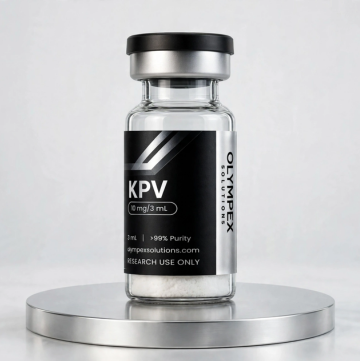
| Specification | Details |
|---|---|
| Compound Name | KPV |
| Full Name | Lys-Pro-Val |
| Type | Tripeptide |
| Quantity | 10 mg |
| Purity | ≥99% (HPLC Certified) |
| Form | Lyophilized Powder |
| Appearance | White to Off-White Powder |
| Solubility | Soluble in Laboratory-Grade Sterile Water |
| Analytical Verification | HPLC |
| COA | Supplied With Each Batch |
$49.99
For Research Use Only | Not for Human or Veterinary Use
KPV is a tripeptide composed of lysine, proline, and valine (Lys-Pro-Val). It corresponds to the C-terminal sequence of α-melanocyte-stimulating hormone (α-MSH) and has been examined in preclinical research involving cellular signaling and inflammatory pathways.
This research material is supplied as a lyophilized powder with a stated purity of ≥99% by HPLC. A Certificate of Analysis (COA) is supplied with each batch for analytical reference.
KPV corresponds to residues 11–13 of α-MSH and has been studied separately from the full-length melanocortin peptide. Research has examined KPV in cellular and animal models involving inflammatory signaling.
In cell-based research, KPV has been investigated in relation to PepT1, a peptide transporter expressed by intestinal epithelial and immune cells. Experimental work has examined whether PepT1-mediated uptake of KPV is associated with changes in NF-κB and related signaling pathways.
These findings come from specific experimental systems and should be interpreted according to the model, methodology, and conditions used in each study.
The supplied product specification lists a purity of ≥99% by HPLC. High-Performance Liquid Chromatography (HPLC) is an analytical method used to separate and characterize components within a sample.
A Certificate of Analysis is supplied with each batch. Researchers can review the applicable documentation for analytical information associated with the supplied material.
KPV is supplied as a white to off-white lyophilized powder. The listed material specification identifies laboratory-grade sterile water as a compatible solvent.
Researchers should refer to the applicable product documentation for material-specific handling and storage information.
KPV represents the three amino acids lysine, proline, and valine, written using their standard three-letter amino acid abbreviations.
KPV corresponds to the C-terminal three-residue sequence of α-MSH, also referred to as α-MSH 11–13.
PepT1 is a proton-coupled oligopeptide transporter that can transport certain small peptides across cell membranes. Research has examined its role in the cellular uptake of KPV.
NF-κB is a family of transcription factors involved in regulating the expression of numerous genes associated with cellular and immune signaling. It is frequently examined in laboratory studies of inflammatory signaling pathways.
No. KPV is a three-amino-acid fragment corresponding to the C-terminal portion of α-MSH, whereas α-MSH is a longer melanocortin peptide containing 13 amino acids.
Published research has examined KPV using cell-based systems and animal models, including experimental models investigating peptide transport and inflammatory signaling.
Review the KPV scientific specifications and applicable Certificate of Analysis when evaluating this material for laboratory research.