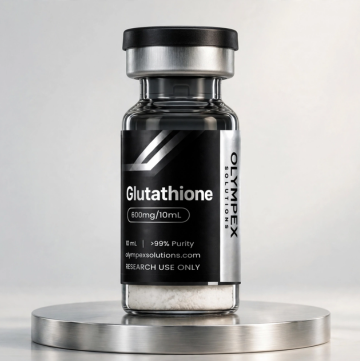
| Specification | Details |
|---|---|
| Compound Name | Glutathione |
| Abbreviation | GSH |
| Peptide Composition | γ-Glu-Cys-Gly |
| Available Quantities | 600 mg / 1500 mg |
| Purity | ≥99% (HPLC Certified) |
| Form | Lyophilized Powder |
| Appearance | White to Off-White Powder |
| Solubility | Soluble in Laboratory-Grade Sterile Water |
| Analytical Verification | HPLC |
| COA | Included in Product Image Gallery |
$39.99 – $44.99Price range: $39.99 through $44.99
For Research Use Only | Not for Human or Veterinary Use
Glutathione is a thiol-containing tripeptide composed of glutamate, cysteine, and glycine. It is a naturally occurring cellular compound involved in redox chemistry and serves as a substrate for several glutathione-dependent enzymes.
This research material is supplied as a lyophilized powder in 600 mg and 1500 mg quantities, with a stated purity of ≥99% by HPLC. A Certificate of Analysis (COA) is included with the product for analytical reference.
Glutathione is a low-molecular-weight thiol found in many cells and is present in reduced and oxidized forms. The reduced form, commonly abbreviated as GSH, contains a reactive sulfhydryl group that participates in cellular redox reactions.
Glutathione also functions as a substrate for glutathione peroxidases and glutathione S-transferases. Research into these enzyme systems examines the role of glutathione in maintaining cellular redox balance and processing reactive compounds.
The supplied product specification lists a purity of ≥99% by HPLC. High-Performance Liquid Chromatography is an analytical technique used to separate and characterize components within a sample.
A Certificate of Analysis is included in the product image gallery. Researchers can review the applicable documentation for analytical information associated with the supplied material.
Glutathione is supplied as a white to off-white lyophilized powder and is available in 600 mg and 1500 mg quantities.
The supplied specifications identify laboratory-grade sterile water as a compatible solvent. Researchers should refer to the applicable product documentation for material-specific handling and storage information.
GSH is the common abbreviation for reduced glutathione, the thiol-containing form of glutathione that participates in cellular redox reactions.
Glutathione consists of three amino acids: glutamate, cysteine, and glycine. Its structure is commonly represented as γ-Glu-Cys-Gly.
Reduced glutathione is commonly represented as GSH, while oxidized glutathione is known as GSSG. The two forms are connected through cellular redox reactions.
Glutathione participates in reactions involving enzyme families such as glutathione peroxidases and glutathione S-transferases. These enzymes have different biochemical functions involving the glutathione system.
Glutathione contains a reactive thiol group that can participate in oxidation-reduction reactions. This makes the glutathione system an important subject in research examining cellular redox processes.
The notation γ-Glu-Cys-Gly describes the three-residue structure of glutathione: glutamate, cysteine, and glycine, with the glutamate residue linked through its gamma-carboxyl group.
Review the Glutathione scientific specifications and applicable Certificate of Analysis when evaluating this material for laboratory research.