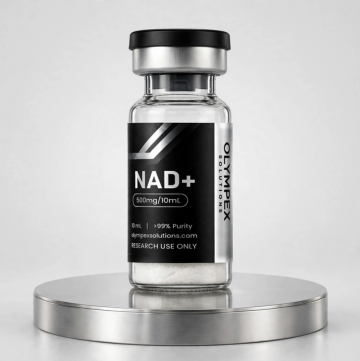
| Specification | Details |
|---|---|
| Compound Name | Nicotinamide Adenine Dinucleotide |
| Abbreviation | NAD+ / NAD |
| Quantity | 500 mg |
| Purity | ≥99% (HPLC Certified) |
| Form | Lyophilized Powder |
| Appearance | White to Off-White Powder |
| Solubility | Soluble in Laboratory-Grade Sterile Water |
| Analytical Verification | HPLC |
| COA | Included in Product Image Gallery |
$64.99
For Research Use Only | Not for Human or Veterinary Use
Nicotinamide adenine dinucleotide (NAD+) is a cellular coenzyme involved in oxidation-reduction reactions and metabolic processes. In its oxidized form, NAD+ participates in the NAD+/NADH redox system and also serves as a substrate or co-substrate for enzyme families including sirtuins and poly(ADP-ribose) polymerases (PARPs).
This research material is supplied as a lyophilized powder with a stated purity of ≥99% by HPLC. A Certificate of Analysis (COA) is included with the product for analytical reference.
NAD+ is present in cells in an oxidized form (NAD+) and a reduced form (NADH). The NAD+/NADH pair functions as a redox system involved in pathways such as glycolysis, the citric acid cycle, and fatty-acid oxidation.
Beyond its role in redox chemistry, NAD+ is consumed by several enzyme families. Research has characterized NAD+ as a substrate or co-substrate for sirtuins and PARP enzymes, connecting NAD+ metabolism with cellular signaling and protein modification processes.
Research into NAD+ biology also examines how cellular NAD+ pools are maintained through synthesis, recycling, compartmentalization, and enzymatic consumption. These processes vary between cellular compartments and experimental systems.
The supplied product specification lists a purity of ≥99% by HPLC. High-Performance Liquid Chromatography (HPLC) is an analytical technique used to separate and characterize components within a sample.
A Certificate of Analysis is included in the product image gallery. Researchers can review the applicable documentation for the analytical information associated with the supplied material.
NAD+ is supplied as a white to off-white lyophilized powder. Lyophilization is a controlled drying process commonly used to prepare laboratory research materials in a dry form.
The supplied specifications identify laboratory-grade sterile water as a compatible solvent. Researchers should refer to the applicable product documentation for material-specific handling and storage information.
NAD+ stands for nicotinamide adenine dinucleotide in its oxidized form. It is a naturally occurring cellular coenzyme involved in redox chemistry and other enzyme-dependent processes.
NAD+ is the oxidized form of the NAD redox pair, while NADH is its reduced form. Cells continuously interconvert these forms during metabolic reactions involving electron transfer.
NAD+ is used as a substrate or co-substrate by several enzyme families, including sirtuins and PARPs. These enzymes consume NAD+ while carrying out their respective cellular reactions.
Cellular NAD+ levels are regulated through a balance of biosynthesis, recycling, and enzymatic consumption. Mammalian cells use multiple pathways to produce and replenish NAD+.
NAD+ is distributed across several cellular compartments, including the cytoplasm, mitochondria, and nucleus. The concentration and regulation of NAD+ can differ between these compartments.
NAD+ is studied because its redox chemistry and enzyme-dependent functions are closely connected with cellular metabolic pathways. Research examines how NAD+ availability and NAD+/NADH balance relate to these processes.
Review the NAD+ scientific specifications and applicable Certificate of Analysis when evaluating this material for laboratory research.